Case Study · December 2017–October 2018
Enterprise Fleet Card and Fuel Expense Management Portal
Enterprise Fleet Card Portal
Lead Developer · Kinetique Systems Inc.
A production customer portal for a major Philippine petroleum company, combining ASP.NET Core 2.0, a layered application foundation, SAP workbook imports, request-driven Fleet-service access, and major Fleet Card workflows, delivered through Kinetique Systems Inc. with a small development team. My backend-focused contribution covered the ASP.NET Core 2.0 and Onion Architecture foundation, data-access and service-integration patterns, major Fleet Card workflows, and a testing foundation for ongoing delivery.
- ASP.NET Core 2.0
- C#
- SQL Server
- Onion Architecture
Project Context
A customer portal brought several enterprise workflow models into one maintainable application.
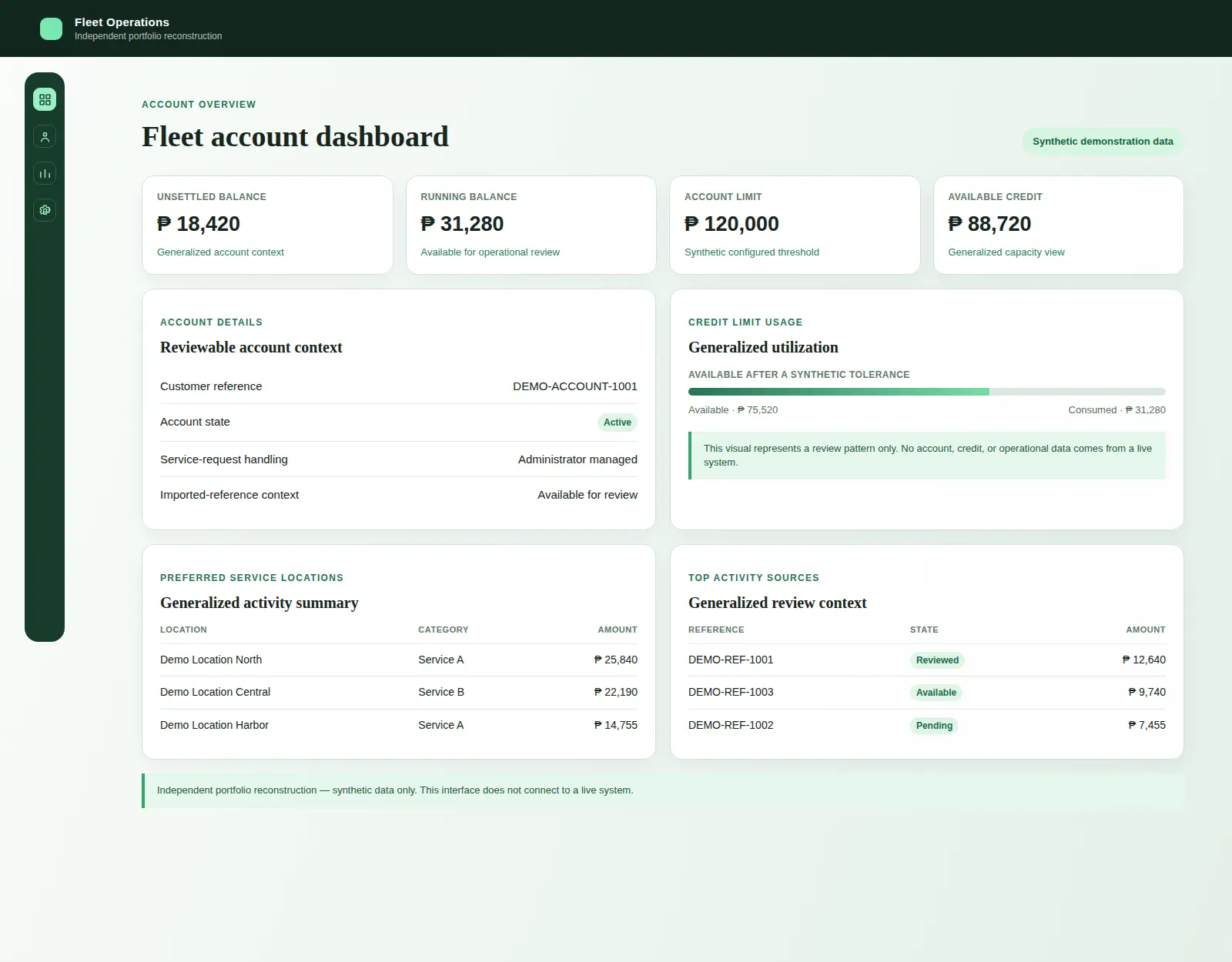
The portal supported account context, Fleet Card workflows, reporting, statements, and administrator-managed service requests. It treated SAP workbook imports, request-driven Fleet-service access, and locally reviewed requests as distinct operating models rather than presenting them as one uniform workflow.
Technical Leadership and Contribution Boundary
I established the application foundation and led major workflow delivery within a collaborative team.
I selected and established the ASP.NET Core 2.0 foundation, using Onion Architecture, dependency injection, and testable boundaries. I created the initial project structure, Entity Framework Core data-access patterns, reusable service-integration approach, application-security foundation, web-interface direction, and testing setup.
I also implemented major Fleet Card account-management workflows. A co-developer contributed across SAP functionality, background operations, authorization claims, notifications, tests, and other portal features; the complete system was delivered collaboratively.
Architecture and Integration Boundaries
Onion Architecture provided a practical foundation for maintainable portal and integration work.
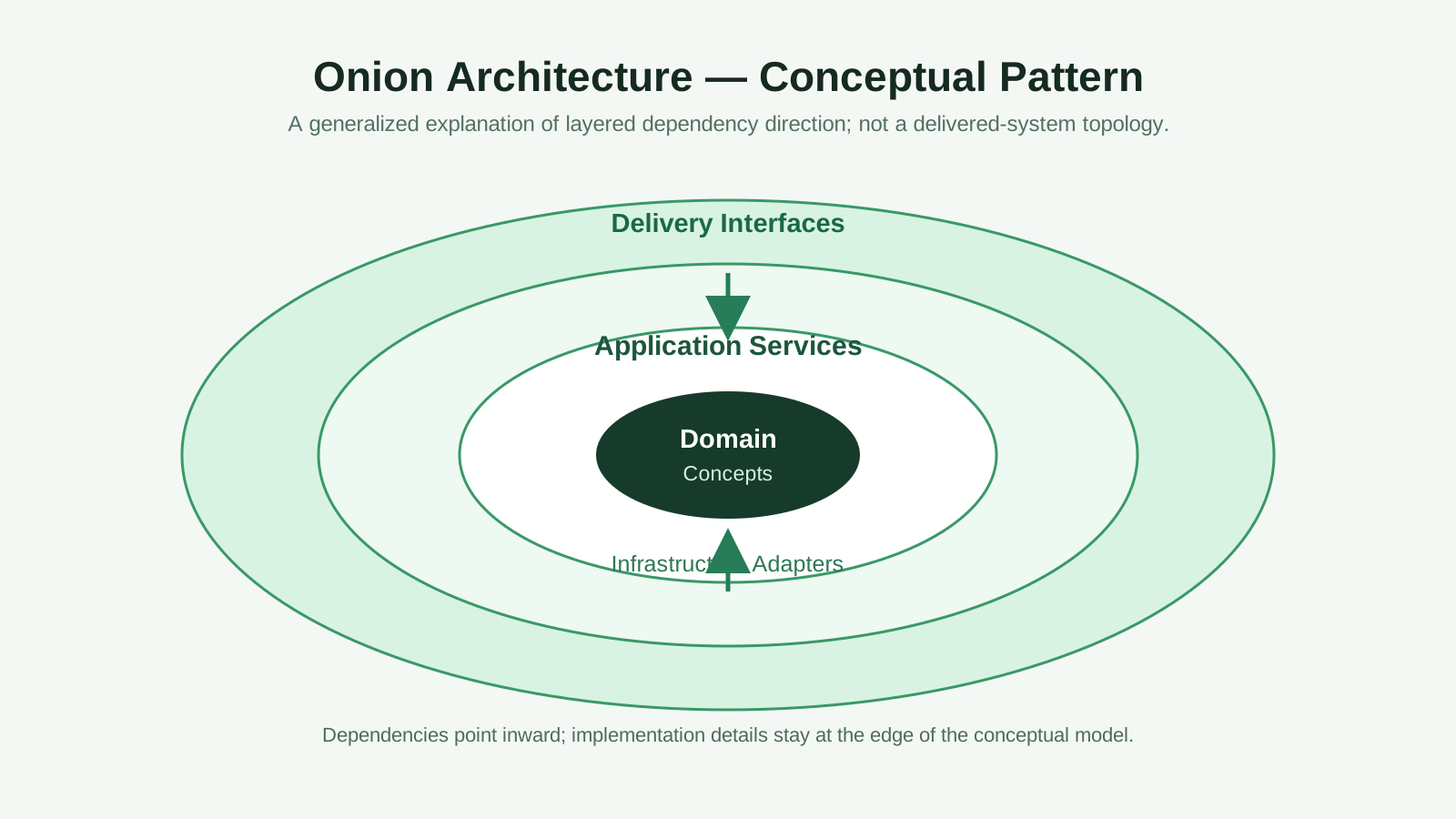
The application used ASP.NET Core 2.0, C#, Entity Framework Core, and SQL Server with generalized layered boundaries. The conceptual diagram below explains the Onion Architecture pattern used in the project; it is not a diagram of the delivered system, its topology, or its integrations.
Data, Services, and Operations
Integration work preserved distinct boundaries between imported, requested, and administrator-managed information.
I established data-access and service-integration patterns and contributed shared SAP workbook-import and Fleet-service integration work. SAP information was imported through workbook-based processes; Fleet account and card information was accessed through request-driven services; and selected service requests were stored for administrator review. This description intentionally omits provider details, private routes, credentials, and production operating data.
Workflow Quality and Delivery
Customer workflows and testing were built as part of disciplined team delivery.
I contributed customer-workflow and automated-testing work, including an xUnit- and Moq-based foundation for unit and integration testing. The portal reached production through team delivery in collaboration with client technical and operational personnel. This case study does not make a current-availability claim or imply that every workflow was individually authored.
Technology Stack
ASP.NET Core and SQL Server at the center, with integration and testing context kept distinct.
Primary
- ASP.NET Core 2.0 · C#
- Onion Architecture
- Entity Framework Core · SQL Server
- Dependency injection
Integration and data
- SAP workbook imports
- Request-driven Fleet-service access
- Administrator-managed workflows
Interface and testing
- Razor
- JavaScript
- jQuery
- xUnit
- Moq
Available for senior remote opportunities